Write better prompts for Ask Albert
A specific question gets a specific answer. Ask Albert uses exact filters for names, IDs, and numeric ranges, and meaning-based search for notebooks, documents, and descriptive questions. The more your question says about the material, the project, and the measurement, the closer the matches. Use this page when a vague question returns too much or too little.
The short version
A strong prompt usually has four parts:
Part | What to say | Example |
|---|---|---|
Action | What you want back: a list, a table, a comparison, a count | "List...", "Compare...", "Which..." |
Subject | The material, formula, task type, or data you mean | "formulas made with VM & P Naphtha" |
Scope | The project, template, tag, or person that narrows it | "in project P539" |
Measurement | The property, a range, and the unit | "ethylene content between 30 and 35 wt.-%" |
You don't need all four every time. Each part you add narrows the search.
Show a table of formulas in project P539 with ethylene content between 30 and 35 wt.-%
That prompt has all four parts:
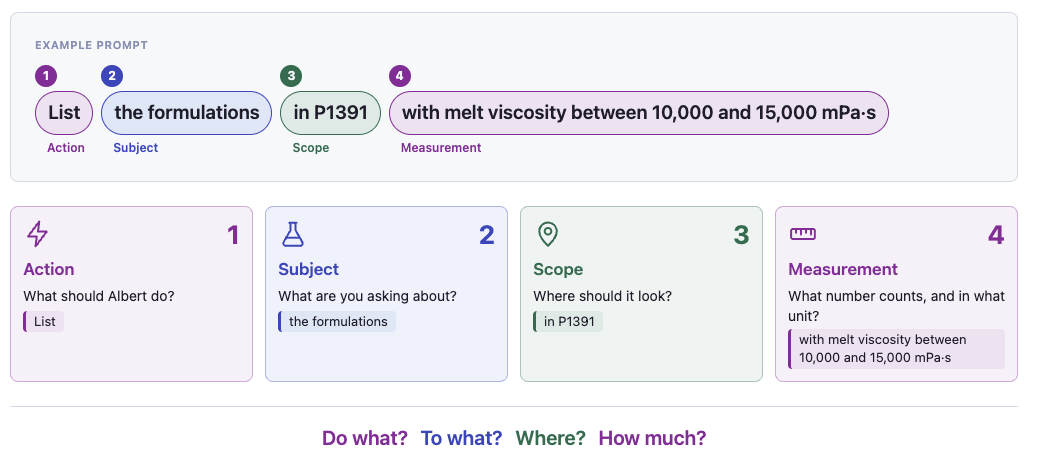
Write a specific prompt
A specific prompt names a thing and a measurement. For example:
"Show me batch tasks using DI water" works better than "Show me batches".
“In project P539, which formulas have an ethylene content between 30 and 35 wt.-%?”
"Are there any pour point measurements between 18°C and 25°C for lubricant formulas?" works better than "Find lubricant formulas with a low pour point".
Include the unit with every range, for example "18°C to 25°C". Ask Albert matches the unit your data is stored in, so a range in another unit can return nothing. If a range search comes back empty, ask how that property is stored.
Ask Albert uses the language of your field, so you do not need to simplify chemistry terms. Questions such as "Do we have any fatty acid methyl esters in our inventory?" or "What thermoplastic polyurethane elastomers have we worked with?" are fine. If a trade name returns nothing, describe the function instead, for example "surfactant for low-pH systems".
Use the page you are on
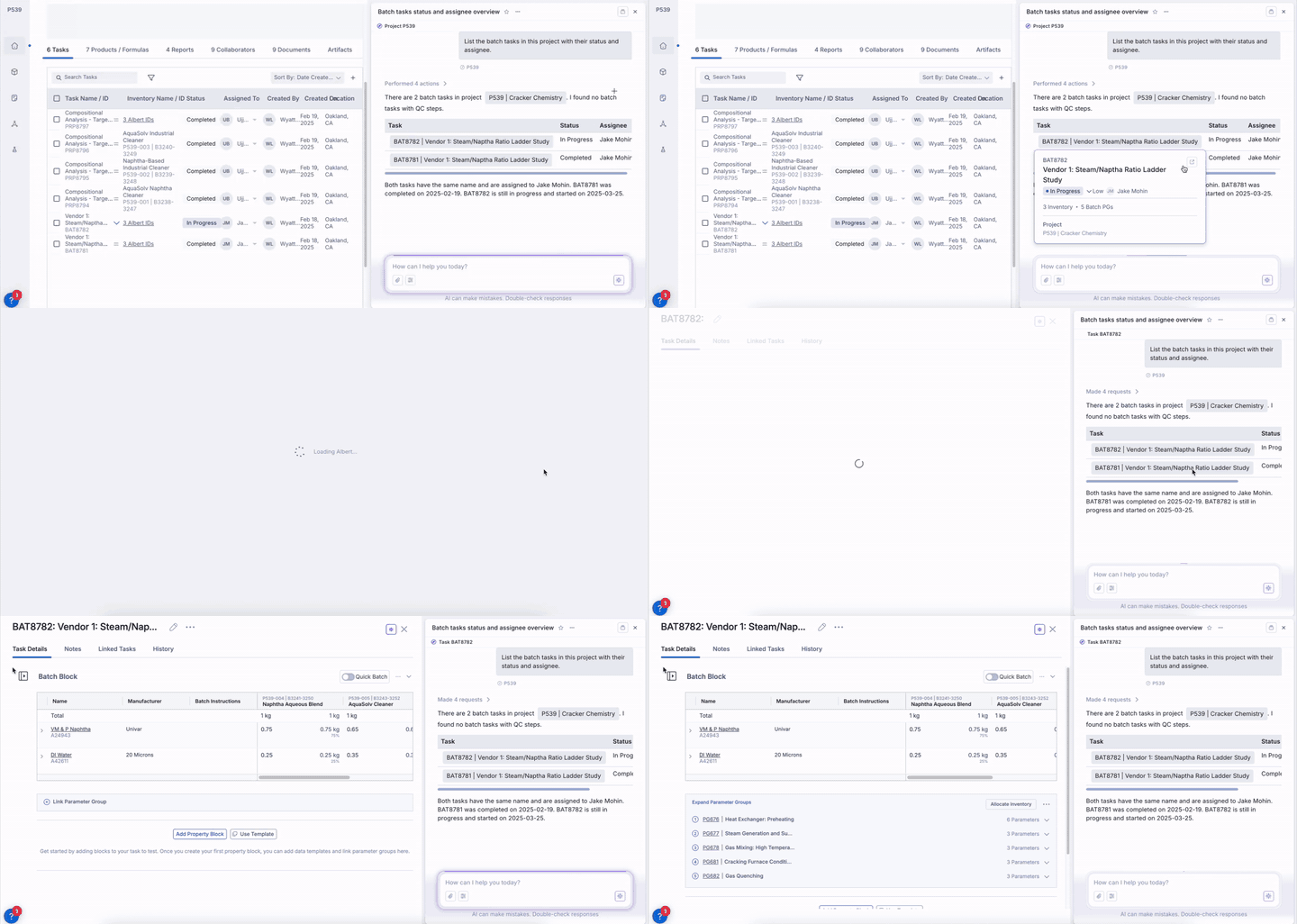
Ask Albert knows what you are looking at. Open it from any record and ask about “this.” For example, open a raw material page and ask “What formulas use this raw material?” or open a project and ask “What notebooks have we used here?”
Conversations follow you across pages, so you can ask on one page and keep going on another.
Narrow results with follow-up questions
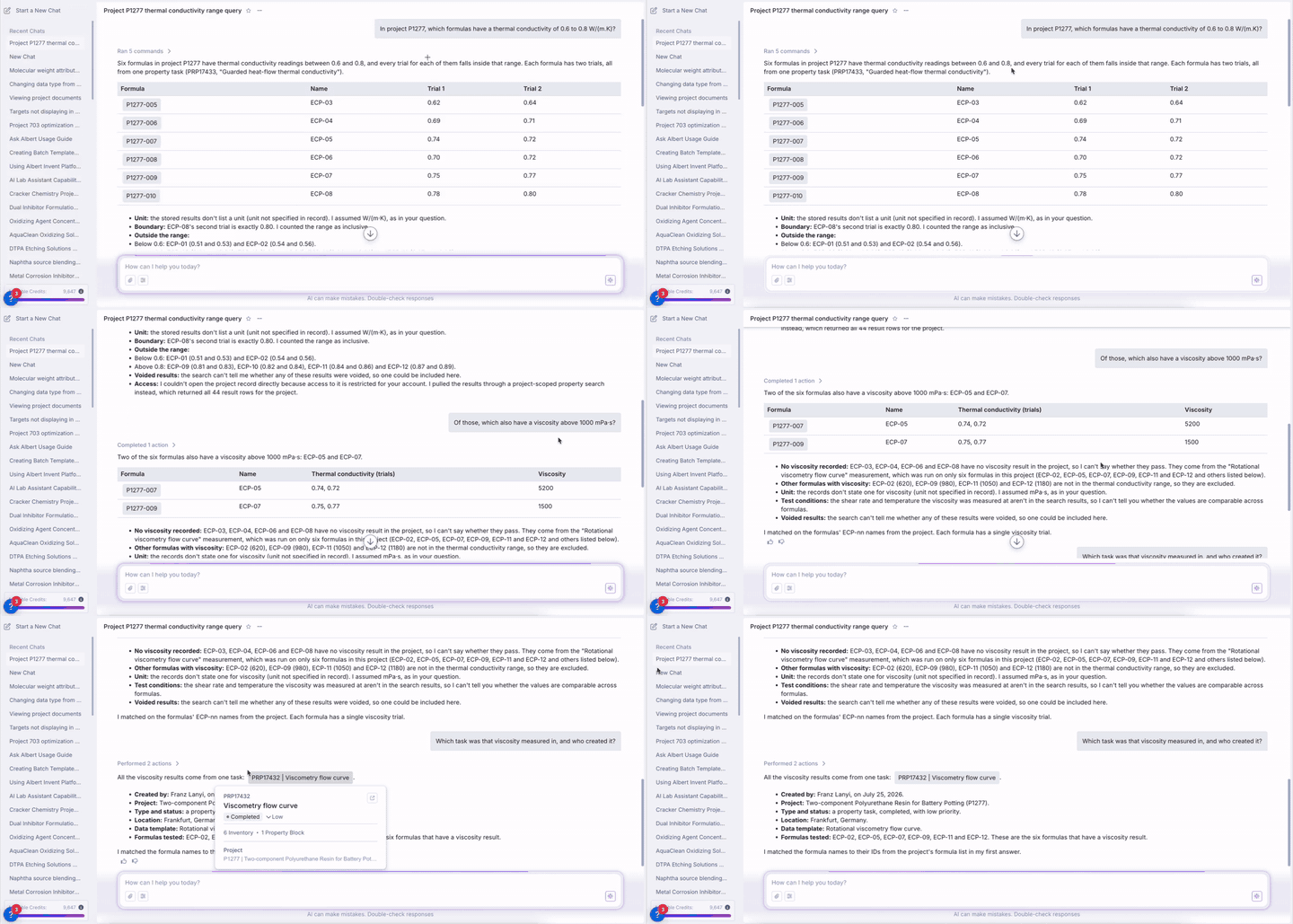
Start broad and add one condition at a time. Ask Albert keeps the conversation context, and each follow-up runs a new search that builds on what came before.
For example, ask for all projects that use a raw material, then ask which of those projects have the highest value for a property, then ask which batch tasks were run for them. Each follow-up refines the last answer without repeating it.
Example 1: from a material to the lab work
"Show me all projects using DI water as a raw material."
"What inventory items are critical to the cracking chemistry process?"
"Which worksheets in that project have the highest values for the property I care about?"
"What batch tasks were run for those formulations, and what equipment was used?"
Example 2: from a range to a shortlist to the source
"In project P539, which formulas have an ethylene content between 30 and 35 wt.-%?"
"Of those, which also have a propylene content above 24 wt.-%?"
"Which property task and lot was that measured in, and who ran it?"
Tips for follow-ups
Add one condition at a time. If a result looks off, you can see which step caused it.
Use "those," "that project," or "the first two" to refer back to earlier results.
If a thread drifts, start a new chat. A fresh chat has no earlier context.
Example prompts by type of search
Starting a new project: "I'm starting a new project on UV-resistant coatings for industrial applications. What have we already developed?" The answer summarizes the most relevant records.
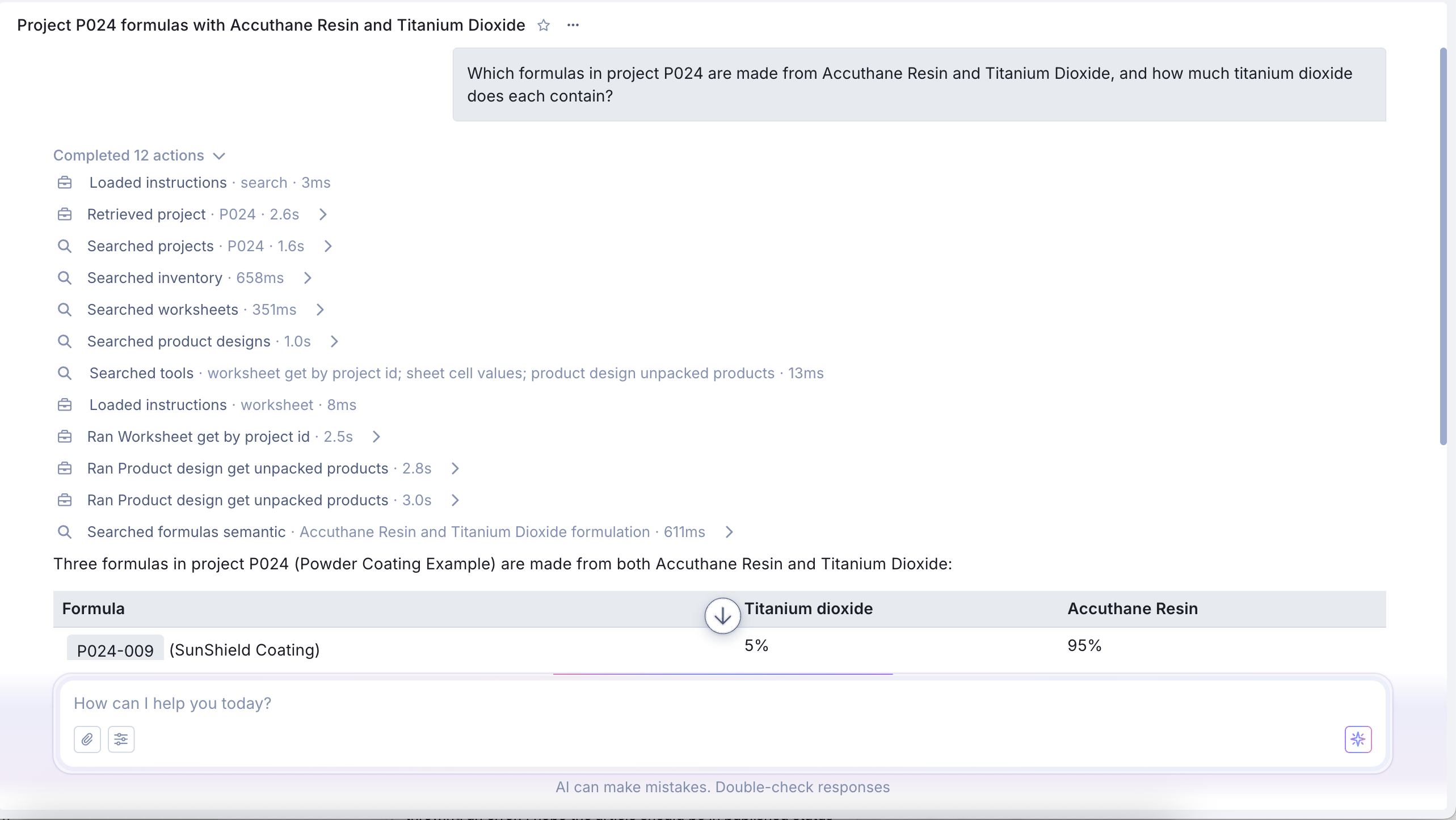
Searching property data: "Which formulas in project P024 are made from Accuthane Resin and Titanium Dioxide, and how much titanium dioxide does each contain?"
Finding alternatives: "Are there alternatives to Efka FL 3730 that we've worked with before?"
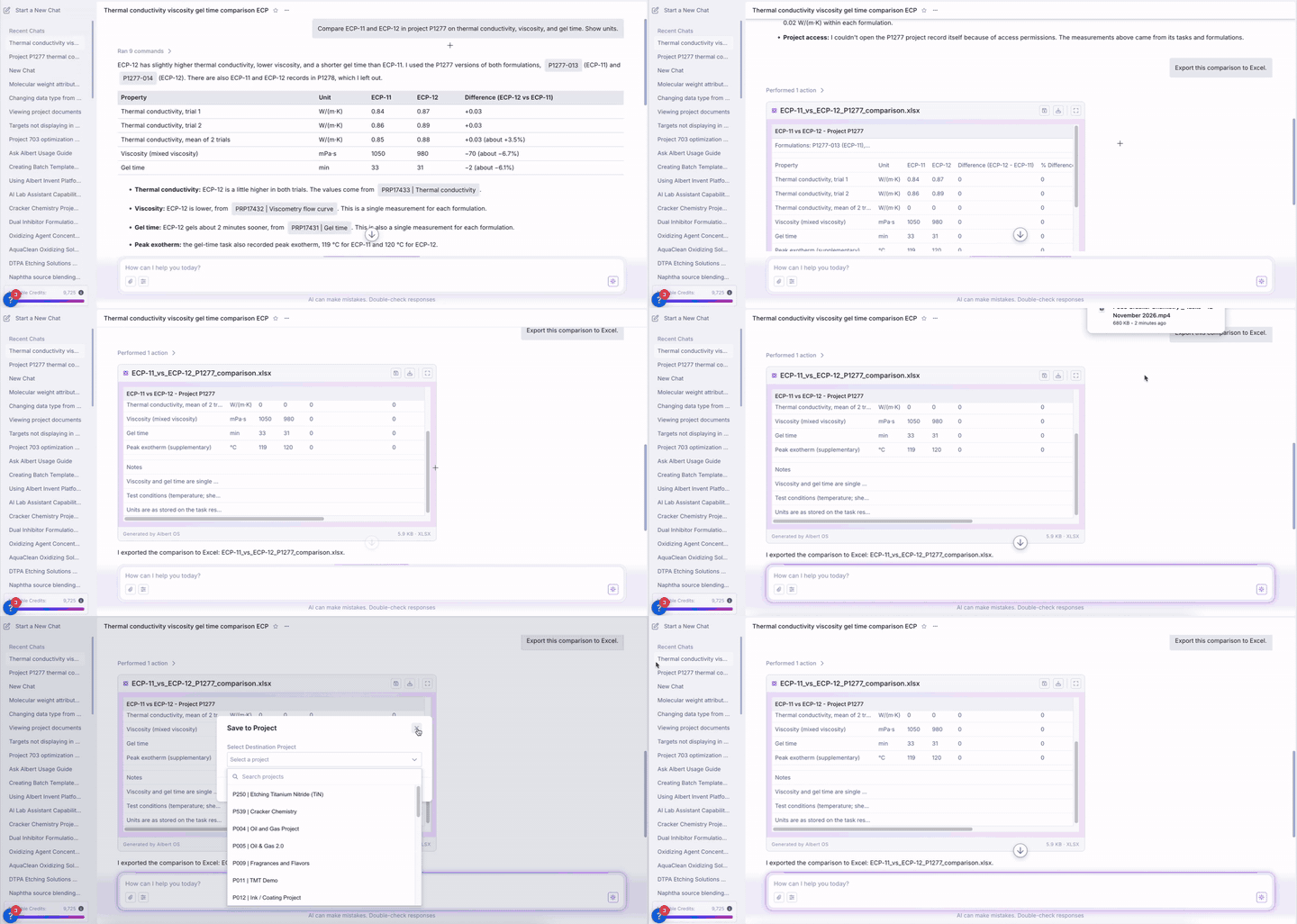
Comparing: "Compare ECP-11 and ECP-12 in project P1277 on thermal conductivity, viscosity, and gel time. Show units."
Finding "things": "List the batch tasks in project P1277 tagged ev-battery. Include status and the formulas each one covers."
Searching a range: "Find all batch tasks where the steam:naphtha ratio was above 0.5 in project P539."
When you search batch tasks or property data, naming the project, the material, or the data template helps Ask Albert find the right records.
Turn an answer into a file
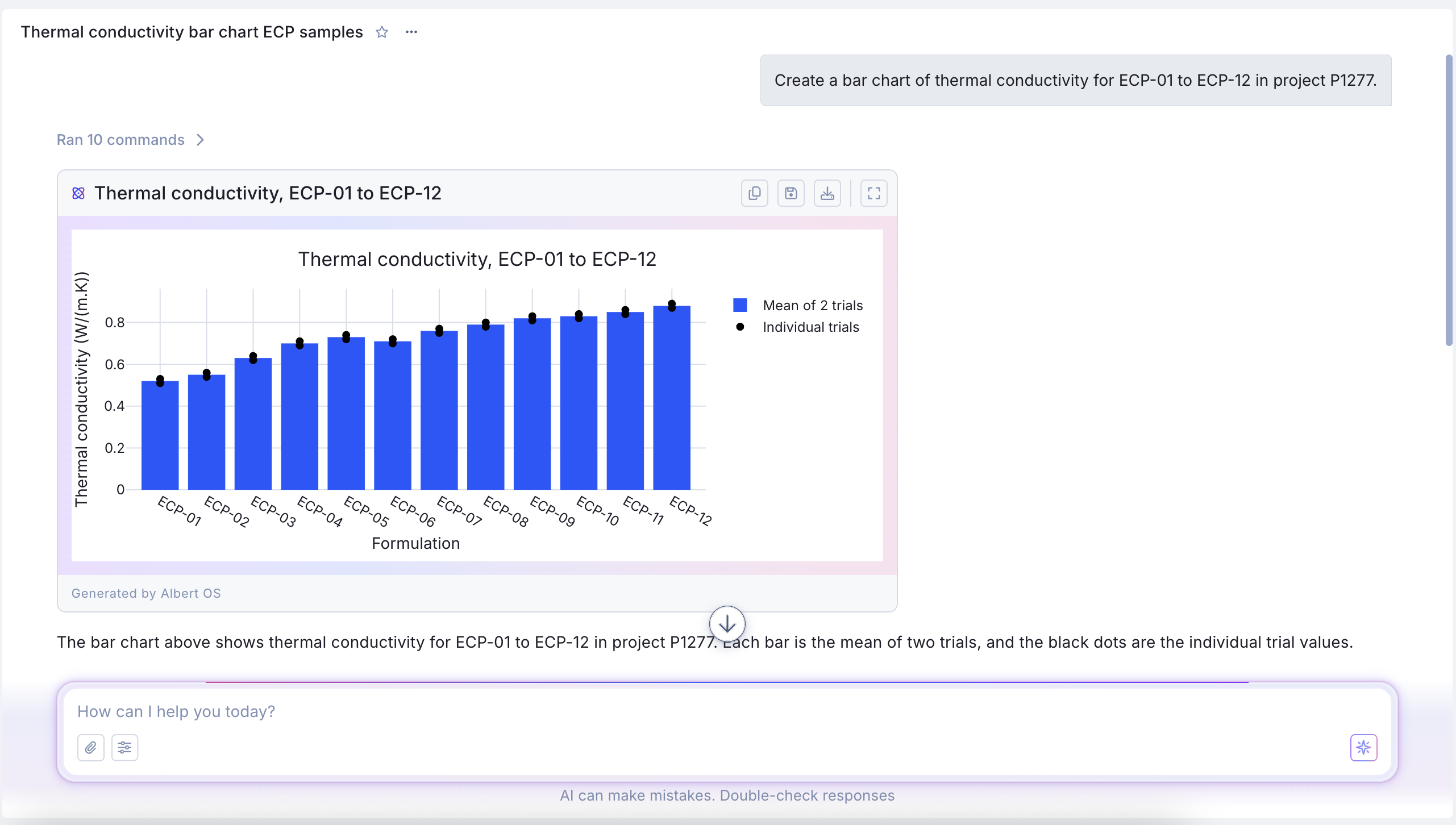
Ask Albert can also put results into an Excel table, a Word document, a PowerPoint deck, or a chart.
Say the file type and which records to use. These requests work well:
“Export these viscosity results to Excel.”
“Create a bar chart of R-values across these formulations.”
“Build a PowerPoint summary of this project.”
“Generate a formula report for P301-002.”
“Generate a lot label PDF for LOT12345.”
Files include only data that exists in Albert when you ask. Blank fields and unlogged results won’t appear. To correct a file, reply in the same chat — for example “use a bar chart instead” or “include only lots from Q1 2025.”
Ask across record types
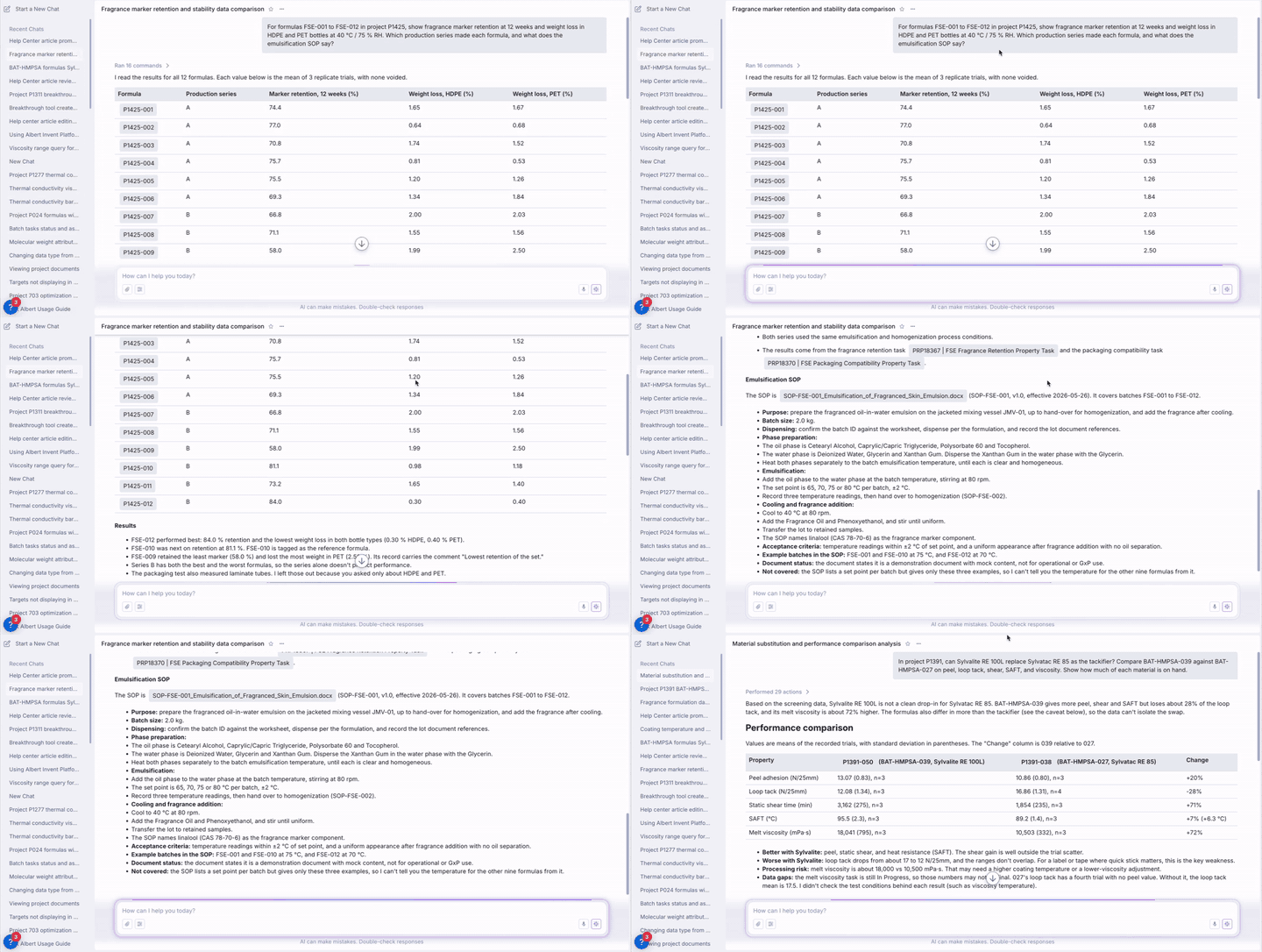
Some questions span more than one kind of record: a formula, the batch that made it, the measurements that came out of it, and the notebook that explains the decision. Ask Albert can combine these in one question.
Formulas supply composition.
Batch tasks supply manufacturing steps and process settings.
Property tasks supply measured results.
Notebooks supply context, such as why a candidate was chosen.
Naming the project and the material or formula together helps Ask Albert find the right records. For large scopes, split the question into steps.
Example: From screening to lead candidate.
Compare the formulas in a screening project that use a given raw material. For each one, pull its test results and the batch task that made it, then summarize the reasoning in the project's decision record. This shows how one question can draw on four record types.
Use Ask Albert to weigh options
Ask Albert can point to records that bear on a choice, such as a raw material you used before as an alternative, or the formulas a switch would affect. It works only from the data in Albert and doesn't verify chemical equivalence. You make the decision.
Tell Ask Albert what the answer will be used for, which constraints matter, and which trade-offs are acceptable.
Raw material substitution
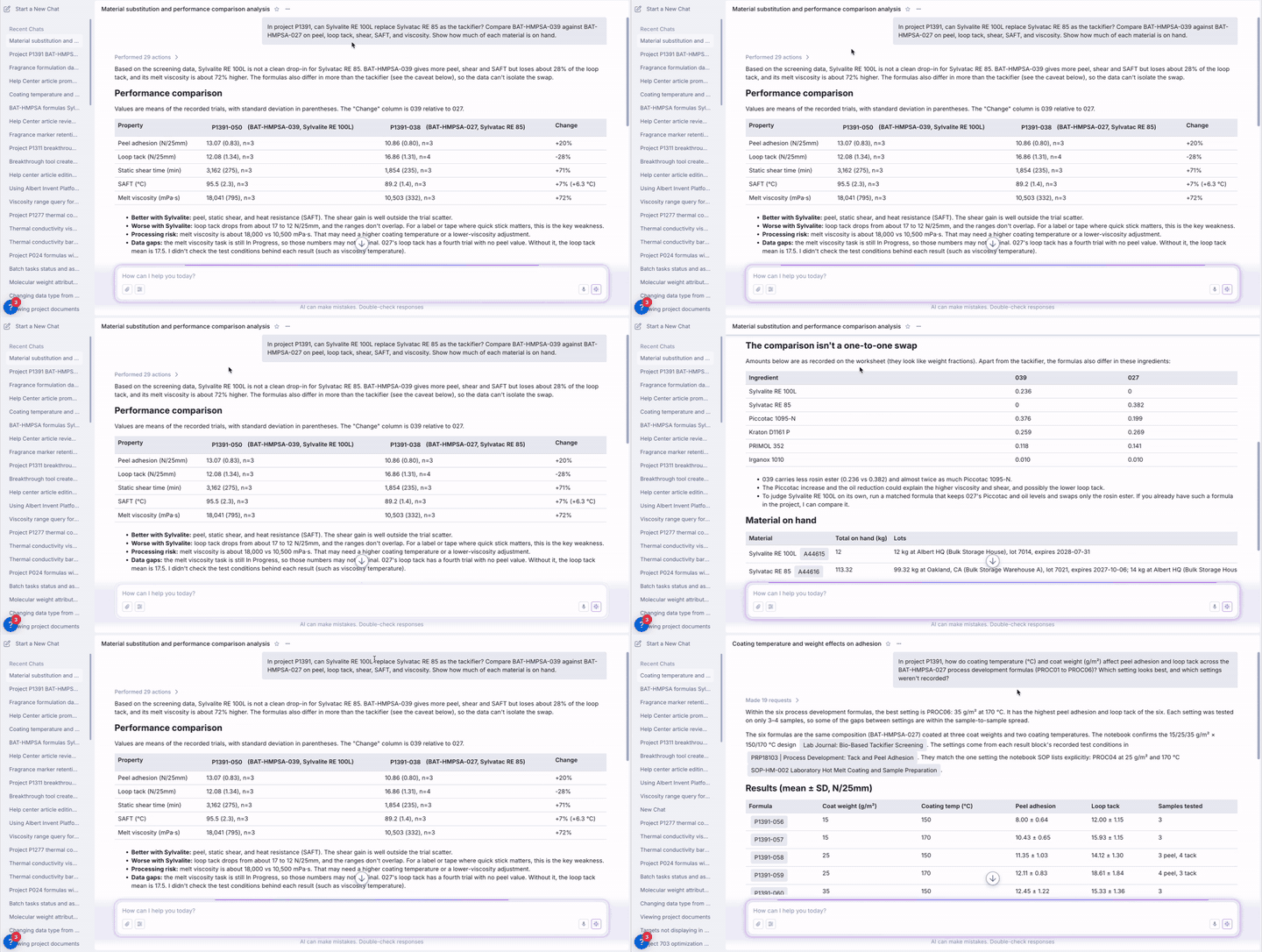
Ask whether one material can replace another in a specific project. Ask Albert can compare the formulas that use each material on the results you care about, and show how much of each is in stock. The comparison shows where one option is stronger and where it is weaker.
Example: Compare a candidate replacement against the current one across adhesion, heat resistance, and viscosity, with stock on hand.
Stock quantities appear as recorded. If the unit isn't stored, Ask Albert says so. Ask only about what your records hold. Cost and supply information appears only if it was recorded.
Process optimization
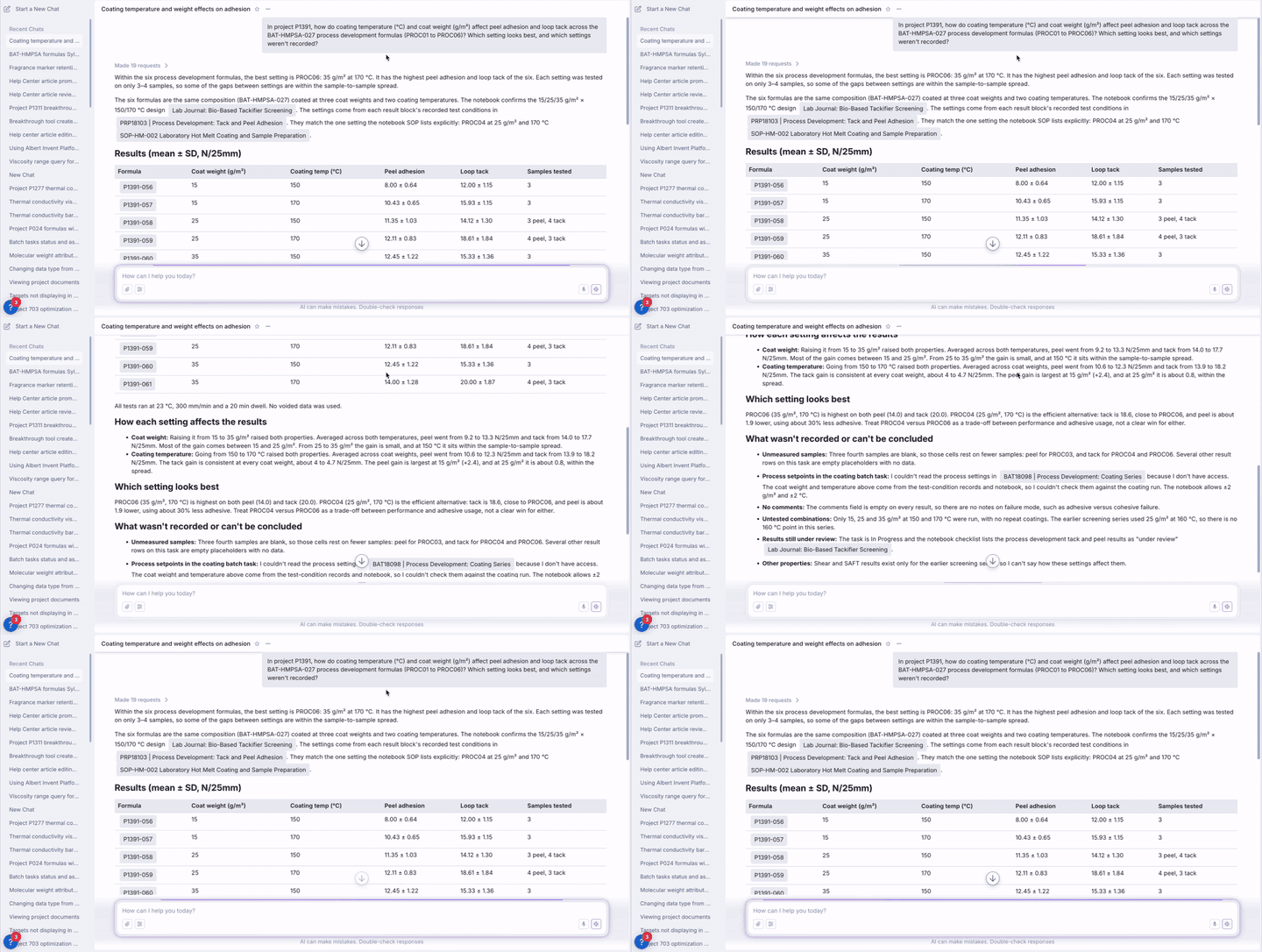
Ask which process settings go with the results you want to improve. Ask Albert reports the patterns in your recorded data, such as how a setting changed a result, and flags settings that weren't recorded for every formula.
Example: Ask which mixing speed and ingredient levels go with smaller droplets, less viscosity loss over time, and better fragrance retention. Also ask which settings are missing.
Ask Albert reports patterns in your data. It doesn't prove cause, and it can't use settings that were never recorded.
Go or no-go decisions
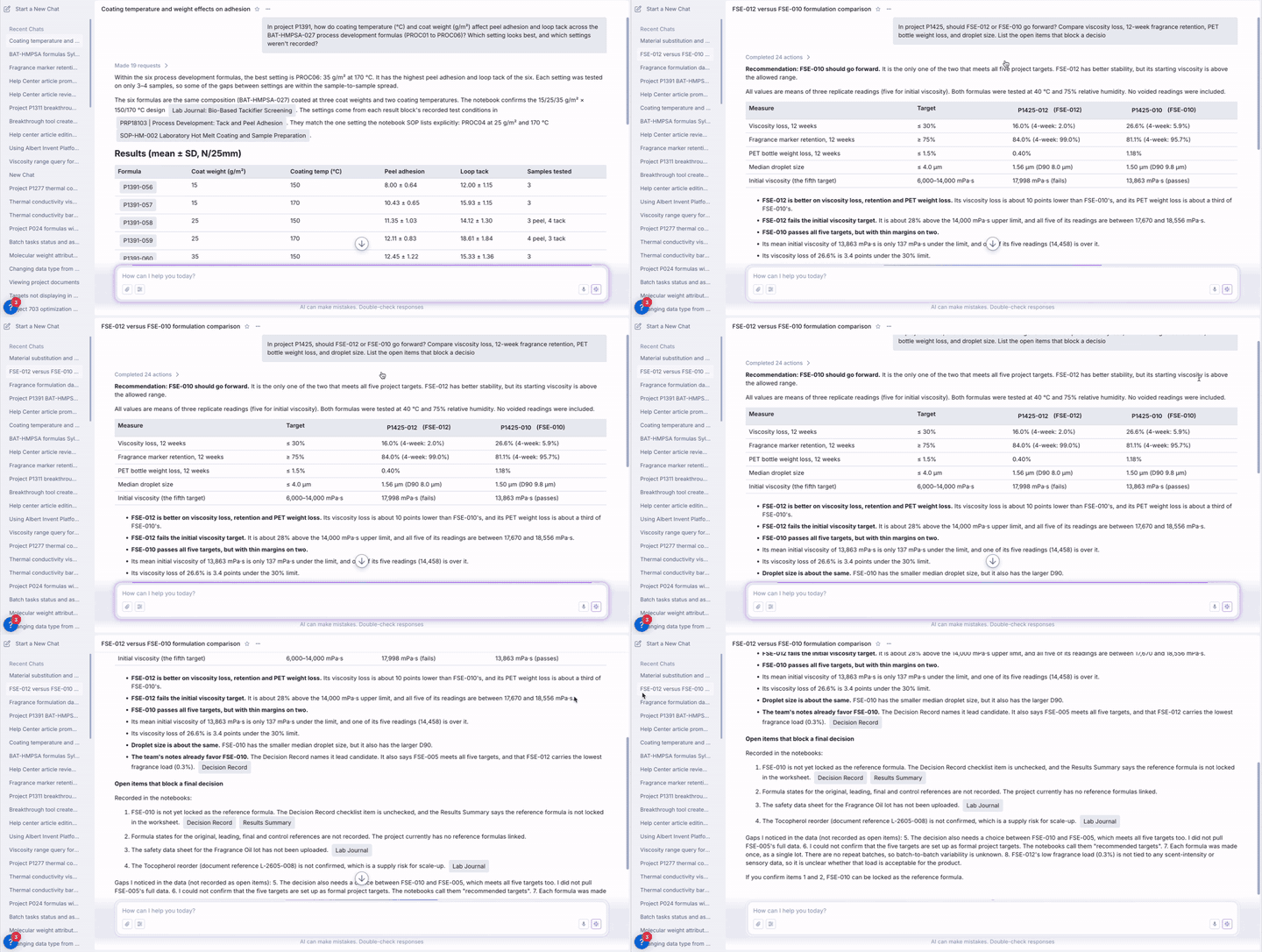
Ask for a comparison of two candidate formulations. Ask Albert can summarize the evidence for each, list the trade-offs, and name the open items that block a decision.
Example: Compare two finalists on stability, retention, packaging compatibility, and droplet size, and list what is still open.
This is a recommendation with evidence, not a decision. If no target values are recorded, Ask Albert can't say which candidate "passes." Constraints that aren't in Albert won't be reflected, so state them in your question.
Check the answer
Expand the reasoning block above the answer to see how Ask Albert read your question, what it searched, and how many records it reviewed. Select the linked records in the answer to confirm details in the original.