
Storage Compatibility
Albert allows you to track and manage storage compatibility to ensure chemicals are always stored in safe conditions. If you try to store unsafe chemical combinations, you will be prompted with a warning message that educates you on the potential risk. The storage compatibility matrix shows you all the warning messages that are possible and which storage class combinations will lead to these warnings. You can find the matrix by clicking on the link, pages 24-27 of the TRGS 510.
Storage Compatibility Matrix Overview
The storage compatibility matrix shows the hazards associated with combining chemicals with certain storage classes.
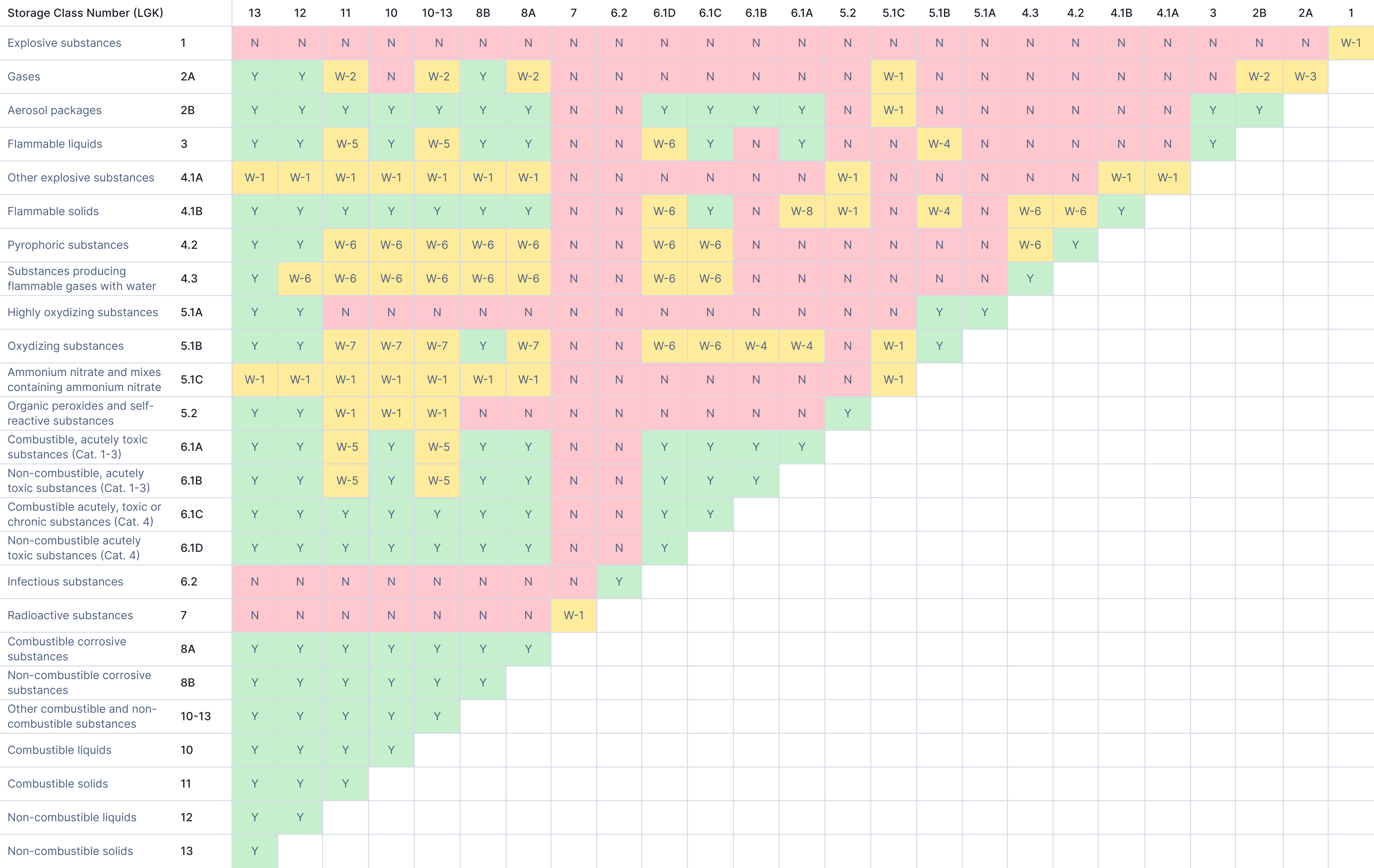
There are 3 tiers of warnings:
Y (green) - storage compatibility is allowed and there are no hazards with this storage.
W (yellow) - storage compatibility is only allowed under certain conditions. There are 7 warning messages, all with different criteria.
W-1: Specific statutory storage rules must be observed.
Storage class 1 and storage class 4.1.A 2. Explosion Ordinance (SprengV)
Storage class 5.1 C: Dangerous Substances Ordinance (GefStoffV) Annex III No. 5 Ammonium nitrate and TRGS 511
Storage class 5.2 BGV B 4 “Organic peroxides”; attention: the joint storage rules quoted here shall also be applied by analogy to self-reactive hazardous substances
Storage class 7 Radiation Protection Ordinance (StrlSchV) and DIN 25422
W-2: Joint storage in rooms is only allowed if:
max. 50 filled pressurized gas containers are stored, of which no more than 25 contain gases that are flammable, oxidizing, acutely toxic, marked with H331 or toxic, and if these
are separated by a wall that is at least 2 m high and made of non-combustible materials and if
a distance of at least 5 m is observed between the wall and the combustible substances.
W-3: Pressurized gas cylinders filled with different gases may only be jointly stored in the same warehouse room under the following conditions:
Pressurized gas containers containing gases that are flammable, oxidizing, acutely toxic, marked with H331 or toxic, provided the total number of 150 pressurized gas containers or 15 pressure barrels is not exceeded. In addition, pressurized gas containers filled with inert gases
may be stored in any quantityPressurized gas containers with flammable and pressurized gas containers with inert gases may be stored in any quantity
Pressurized gas containers with oxidizing gases and pressurized gas containers with inert gases may be stored in any quantity
Pressurized gas containers with acutely toxic hazardous substances of categories 1, 2 or 3/very toxic, toxic and pressurized gas containers with inert gases may be stored in any quantity
In the cases 1 to 3, an additional 15 pressurized gas containers or a pressure barrel containing gases that are acutely toxic, marked with H330, and/or very toxic may be stored. Larger quantities of pressurized gas containers with acutely toxic gases must be stored in a special storage room
There must be a distance of at least 2 m between pressurized gas containers containing flammable gases and pressurized gas containers containing oxidizing gases. .
There are no restrictions as to outdoor storage.
W-4: Joint storage shall be permitted if the restrictions of:
Table 3 are observed for storage classes 3, 5.1B, 6.1A and 6.1B
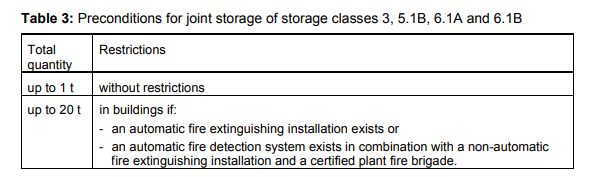
Table 4 are observed for storage class 4.1B with storage class 6.1A.

W-5: Materials that may contribute to the outbreak or rapid expansion of a fire due to their nature and quantity, as e.g. paper, textiles, wood, wood wool, hay, straw, packaging's, combustible packaging filling materials, must not be stored in the warehouse sector unless they form a unit with the non-stationary containers for storage or transport
W-6: Different stored substances may only be stored together or jointly with other materials provided that this will not lead to a substantial increase in risk. A substantial increase in risk can be prevented through separate storage
W-7: Oxidising hazardous materials may be stored jointly with combustible materials:
in quantities of up to a total of 1 tonne without restrictions,
in quantities of more than 1 tonne according to the restrictions under explanation no. 1.
The requirements under explanation 5 must also be observed.
N (red) - storage compatibility is NOT allowed.
(Source): For more information on the joint storage warnings, please review pg. 24-27 of TRGS 510 Storage of hazardous substances in nonstationary containers (asecos.com)